I attend the Patuxent Friends Meeting. I was raised in this meeting, in part, by my mother and father who chose to help build this container with others for their faith and abiding belief in peace. Friends (aka Quakers) carry a core belief in peace and peaceful ways. Nonviolent communication, diplomacy, consensus, and conscientious objection have centuries of discourse amongst Friends.
Part of that Quaker Process involves “witnessing” or “being witness” in trying times. An example of witnessing can be seen in this piece from 1958 delivered by Ira De A. Reid to the Race Street Meeting House in Philadelphia from a series called the William Penn Lectures:
“Our witness tells us that we need not wait for nuclear warfare to strike us before we strip our lives of these superfluities; we need not wait for events to bend our wills to unison. Wherever we are, the worst has already happened and we must meet it. We must simplify our daily routine without waiting for legislation; we must take our political and public responsibilities without having to take the negative action of being “against” nuclear testing, the death-use of science, the military-moulding of education. We must work for the unity and effective brotherhood of man without letting further wars, acts of congresses, decisions of courts, prove that the current pursuit of power, profit and all manners of material and social aggrandizement are treasonable to both Divinity and Democracy. The testimony of inward peace calls for a rebuilding of ourselves, which is no easy formula. For it is not enough for us to do all that is possible: we must do that which seems impossible, bringing to every activity and every plan a new criterion of judgment — a criterion obtained from within.“
The bold emphasis I added because it is the core part of being witness that I believe may be misinterpreted–our orientation to crisis, overwhelm, suffering, war, or emergency involves integration into our very somatic being so that we may see that another way is possible, another world becoming real, and a path to peace open. Indeed, I am speaking to witnessing, orienting to what is happening now, and then moving with coherence towards conscious action.
I draw a line of contrast between the imaginative agency and autonomy Reid references as “witnessing” and the more stoic, perhaps journalistic, gumshoe detective or medical reporter type of “witness”, a supposed emotionally suppressed documentation of facts over which the witness has little control. Reid here calls forward an incarnation, an embodiment of values, orientation to the present moment of conflict, and an imagination of what could happen, not simply what seems like it must happen. Indeed, the act of witness suggests an invitation to pause and consider, rather than rush to act.
To witness, to me, involves looking around me, observing trees and forests, listening actively to instruments and symphony, and clarifying confusions. My nervous system is doing this–the trick is staying present with its assessments towards integrated conscious action. From my somatic therapy perspective, I see a link from the Friends’ notion of witness around core values like pacifism to Somatic Experiencing’s emphasis on orientation in our threat responses. When an unexpected sound or motion occurs (twig snaps or something darts), our physiology cues automatic responses designed to discern whether the unexpected is a threat. We learn habits over time such that we may lose nuance to the unexpected and interpret all unexpected moments as threatening as elaborated in Poly-Vagal Theory.
The trauma we often experience, per Somatic Experiencing, involves a deep interruption in the process of orientation, response, re-orientation, and reflection or rest. Something happened too fast, too quickly, for too long, out of our control, after which our nervous system learned a survival lesson of “never again.” Thus, we may get trapped in any moment during the orientation cycle when a trigger of the trauma is presented. We could be stuck in constant orientation, being hyper-vigilant over our surroundings. Or we may react quickly to any change in our surroundings, moving things, fixing things, acting without permission or need. Or we may resent requests to reflect, reconcile, process, or clarify as burdensome, troublesome, or accusatory. Or we may never take time to reflect, rest, and reset.
In any event, the anchor to our actions remains our capacity to orient, respond, re-orient, and reflect or rest, expanding our capacity for collective well-being through individual knowledge of self. Somatic Experiencing holds that we begin to thrive, not just survive, when we repair our core orientation cycle, allowing ourselves to experience a completion of a thwarted or interrupted response. When we fully witness our autonomic response to our surroundings and consider how fully and imperfectly human each of us is, I find myself humbled by my own autonomic reactivity and others, while bolstered by how quickly our resonant nervous systems seek repair and resolution, when given the space to re-orient and rest. And I find many sources of humor along the way, embracing laughter as a discharge of sympathetic charge over the unexpected that is clearly not a threat. My orientation becomes a felt experience in sensation, not an abstract report on the overwhelm I survived.
We are in trying times. ICE and DHS run amok. MAGA fights with others hoping to save the soul of a nation. Core public health and social welfare infrastructure has been devastated for generations while investments in artificial intelligence, detention and data centers, and weaponry explode. Genocide in Gaza is live-streamed. We are in multiple moments of overwhelm where what we witness invites a dissociated and misanthropic cynicism. Naturally, I want to disconnect, avoid, and not feel the sense that Obi-Wan Kenobi felt when Alderaan was destroyed.
But that old Jedi did not shirk the feeling–he integrated it after acknowledging it. The division, pain, and suffering we are witnessing invite our fully felt sense to recalibrate and adjust. If we stoically report the pain without feeling it, I believe, we recreate the conditions of that emergency room as a perpetual cycle of disembodied suffering, long after we leave the hospital. Dissociated behavior minimizes the pain of others so as to avoid feeling the pain. Associated behavior integrates what is witnessed into a felt empathy that yields action, even if the action is as simple as conscious listening without interruption. Incarnated witness integrates the imagination of what could be to confront the mendacity of the present conflict.
Or as Reid put it, proper witnessing involves a felt sense of the criterion within, the clarity offered through practiced values of reflection, peace, and democratic consensus. Quakers often speak of the inner light, of letting the spirit move one to action, and of taking time to see what happens after the action. I add that the criterion within is a felt sense, a gut instinct anchored by a conscious understanding. When we feel coherent, there is a sense of flow between our gut and our behavior in the world. When there is conflict, we feel that in the gut also and our behavior in the world reflects that sensation. And when we keep learning that the world is too much, we invite each other to dissociate from our guts and maintain a hegemony served by our dissociation or alienation. The arms dealer profits so long as there is war, no matter who “wins”.
For me, a somatic response to our shared social circumstance welcomes the Quaker notion of witnessing as an embodied incarnation of conscious and coherently integrated action that crafts a dynamic and playful world. Social ecologists have long advocated for us to develop counter-institutions that teach us what else we might do together without the structures of oppression and capitalism overdetermining our conditions. We have to experience the utopia to believe in what could be. The simplest way to get there may be feeling a little bit of coherence now, with each other. To do the work of rebuilding ourselves together, daily, through each interaction, and by sharing resources.
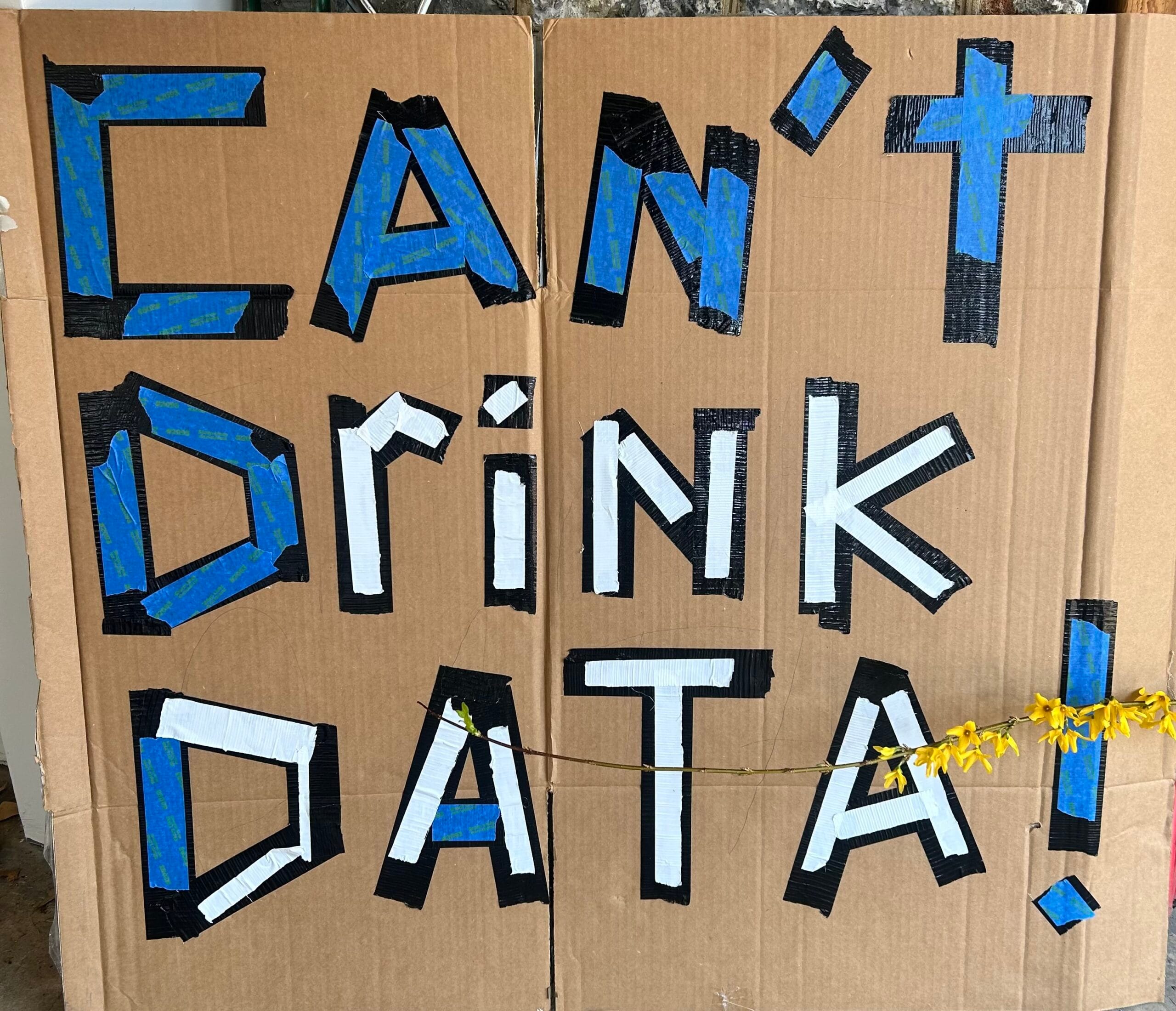
To me, the current discourse about data centers and detention centers demands witness. In concentration camps, human beings are deprived of medical care, legal representation, and access to family. Simultaneously, the powers-that-be foist data centers upon unwilling communities from the source of precious metal extraction to the factories of device construction to the sites of server farms. The juxtaposition of locking up people and farming artificial intelligence remains an abiding watermark of this moment. Social intelligence sacrificed for artificial algorithmic energy vampires, both kinds of centers creating compounds desecrating land and water where they are built.
When such juxtapositions and social contradictions present themselves, I am comforted by the practice of embodied witness, incarnated action, and collective reflection. May we each see rainbows in all the broken mirrors of this time. Perhaps once the structures built to fail, fail, then we can put in place these other ways we have been working on. Other ways of listening, sharing, and seeking peace through resolution, reconciliation, reparations, and regeneration. Ways that don’t wait for permission to find peace, but peacefully gives permission for us all to be and then encourages action that lets us all thrive.
